The disadvantage of the Morse Telegraph was that it required operators with months or years of training to use it. The telephone was invented in 1876, but it was many years before its widespread adoption by railroads.
The 1923 D&RGW Official Roster No. 11 shows telephones at many locations on the mainline standard gauge. At this time, only "telegraphones" were installed on the Narrow Gauge.
The "telegraphone" was a type of telephone that was adapted to use existing telegraph wires. The telegraphone was used on both the D&RGW and Rio Grande Southern railroads. Telegraphones were primarily used for routine communications, for example, between section crews. They were not used for dispatching, as the telegraph was still in service and being used to transmit train orders. This continued to be true on the Narrow Gauge at least until the late 1940s.
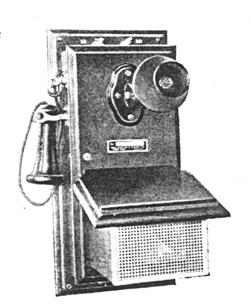
Why did the railroad not simply install conventional telephones ? Primarily because stringing wires is an expensive proposition, sometimes in the hundreds of dollars per mile. Telegraphones were superimposed upon existing telegraph lines by capacitive coupling, along with a "retard coil" to act as an audio-frequency choke. This relied on the fact that telegraph signals are concentrated at low frequencies, while the human voice as transmitted by a telephone is above the highest telegraph frequency. Filters were used in the circuits to seperate the telegraph and telephone signals. This allowed use of the telegraph wire for simultaneous voice and Morse communication without any significant capital expense. The telegraphone worked, however, Norwood implys that they were nothing like today's telephones: "Also, at first, the train dispatchers, used to yelling into the old telegraphones, distorted transmissions by still yelling into the new phone transmitters." (1)
Did the telegraphone replace or only supplement the telegraph ? According to John Norwood, "It did neither , but was rather a system in itself and possible only because it could be installed using Morse wires already in place".
The Telephone
The telegraphone was used only for limited range casual communications. A better telephone system with a reliability sufficient for train dispatching was finally installed on the Narrow Gauge in the 1940s. A telephone requires two seperate wires, and rather than stringing new ones, two of the original telegraph wires were utilized for telephone circuits. The two-wire circuit provided better range and intelligibility than the single-wire telegraphone, and thus it finally became the primary dispatching tool on the Narrow Gauge. The remaining telegraph circuits remained functional into the mid-sixties and were occasionally used when the busy dispatcher's telephone could not be interrupted. Also the remaining agent-operators continued to use the telegraph at any opportunity, as they were proud of there hard-won ability and loyal to their craft.*
A technical training manual from 1913 summarizes the utility of the telephone in serving the railroads:
"Although the telephone has, for many years, been used for the transaction of business between the various departments of steam railroads, it was not until 1908 that the telephone was used to any considerable extent as a substitute for the telegraph in the dispatching of trains. But now telephone train-dispatching systems have been installed and are in successful operation on approximately one-half of the railroad mileage of North America. Telephone train-dispatching systems have the further advantage that they can be used by any member of the train crew."(2)
In reality the telephone was fought tooth-and-nail by the telegrapher's unions. Trainmen or conductors talking directly to a dispatcher via the telephone was bad news for labor relations, and the telegraphers would aggressively "time-slip" the transgressors when caught.
*"Order of Railroad Telegraphers" was a brotherhood dating back to the late 19th century. The ORT continued into existence until the mid 1960s, when it was absorbed into the Transportation Communications Employees Union.
2. "Telephone Train Dispatching", by I.C.S Staff and Chas. Stanley Rhoads. International Textbook Company, 1913.