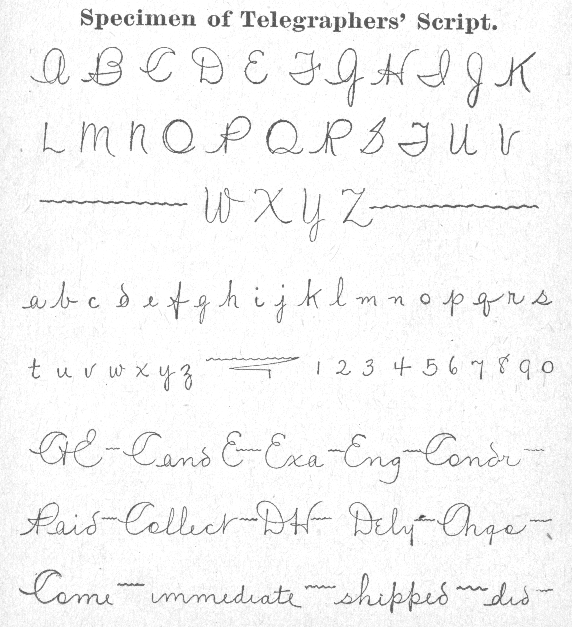
Good penmanship was a must. Although not all learned that rolling rounded telegrapher's script that was the trademark of the old-time Brass Pounder. On the whole telegraphers wrote a clear clean writing. Another thing it was necessary to develop was a pressure just sufficent to make impression for the number of copies of train orders being made, yet not tear the "flimsy" (dialect for train orders because of the fine thin paper used and the fact there was a double-sided carbon between each sheet). Each operator at multiple shift train order offices was expected to leave two or three pads of the three forms of train orders- '31', '19' and 'MB' set up for the next shift. That is a pad was set up with a carbon between each two sheets.
Example of Telegrapher's Script from training manual
Training the Telegrapher
Operators on watch at the receiving mechanism* after a period of time spent watching the tape began to notice that the tape embosser could be "read" by sound . Shortly "sounders" almost the same likeness as the last ones used were devised. Two coils set up magnetic fields that pulled the spring loaded 'arm' bearing an armature down. In the sequence of sending when power was off the spring loaded arm moved upward and struck the "sounder" end of the gadget to make clicking sounds - short, long and extra long. The Morse Code is the combination of these dots, dashes and long dashes that makes a letter, numeral, or punctuation. To the adept listening to the clicks and converting them to letters was like becoming the possessor of a second language. Almost all of us could carry on a conversation with someone as we typed or wrote the words of an incoming message. Many commercial and RR Relay operators could work as much as 10-15 words behind. My father was one such but my tenure as an operator was too short - three or four words behind was the best I ever achieved. The writing of operators became stylized into a flowing rounded form so universal it was easy to recognize an ex-lightning slinger by his writing. It was a result of having to write rapidly and clearly but in a manner that did not tire or cramp. All handwriting and key operation depended upon the rounded forearm just below the elbow and above the wrist "rolling" freely- the elbow firmly on the desktop and the lower portion, wrist and hand 'floating' freely and touching no surfaces. Even thus "telegrapher's arm" became an occupational disease so bad many had to give up, learn to send with the left hand or go to the Vibroplex. The direct cause, of course, is due to too many repetitive movements. Now called carpal tunnel syndrome, computer operators are extremely vulnerable.
* The original Morse receiving instrument was called a "register". It embossed the dots and dashes on a moving paper tape. This was a cumbersome arrangement and was soon replaced by sound reading from the much simpler "sounder" which converted the electrical pulses of the Morse code into clicking sounds.