At the outbreak of WWII, the country turned to railroads as one of the critically needed transportation means. There became a need for Morse in some cases, but as a whole telephones on main lines and teletypewriters took up the slack. The D&RGW employed a number of WU telegraphers (telephoners); gave them a brainwashing in handling receipt and delivery of train orders to passing trains. It was not a gladsome substitute.
On the Rio Grande there were many branch and secondary mains where messages and train orders depended on Morse. In the beginning there were only four of us younger dispatchers already assigned who could work with both Morse and telephones on such districts. More Morse operators were in training for train dispatching, but they were not yet ready.
A second set of dispatchers was established at Salida and the four of us assigned to man it. We were on this about two months when four of the students were promoted. They were assigned to the second set of dispatchers at Salida and our team was sent to Grand Junction to man a another dispatching office. As at Salida, when four more newly promoted students became available our team was moved to Salt Lake and manned a desk for handling all the branches and portions of the Main Line. This was the last new set established. We had to use both Morse and telephone at each of these new assignments. Proper equipment was difficult to get.
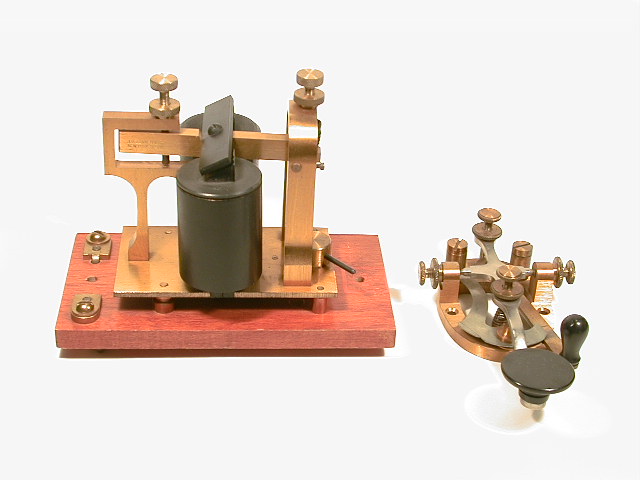
At each of the three DS assignments a combination talk/listen apparatus was furnished to keep in place over the left ear for use where communication was by phone; telegraph equipment for communication in non-phone Districts. We had only one headset for all of us, a heavy transmitter rested on our chest hanging on a strap around our necks. The receiver was an old fashioned round one held in place by a piece made of a springy steel spring wire; there was no padding. The receiver had to be worn constantly as there was no speaker to tell us a telephoner was on the line.
Try listening to an aural report coming by phone and a second one being received via a chattering sounder; keep the contents separated and in proper context........ you ain't lived yet until you experience this day by day.
At last the War over and phone equipment being available readily and cheaply, and teletypewriters being sold a dime a dozen, Morse men became anachronisms - the dinosaurs of the railroad industry.