Wrecking Box Images
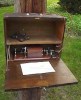
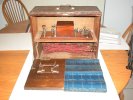
The box itself is 17x13.5x8 inches. It is sturdily constructed of hardwood. The box sides are dovetailed and clearly designed for strength and rough treatment. The hardware is all brass. The main lid folds out and is held level by a brass arch stop on the left hand side. This was intended to be used as a desk in the field. The interior of the box is divided into three compartments. The upper compartment holds the "box relay". The lower section has a very small compartment for storage of message blanks and train orders. The remainder of the compartment is for storing the wire and "wrecking clamp". Two electrical binding posts are located on the right side of the lower compartment for connecting the main circuit wires with the box relay.
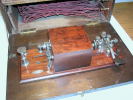
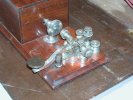
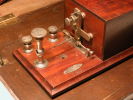
A "box relay" consists of a telegraph key (the transmitter), and a "main line" sounder (the receiver). A "main line" sounder is designed to work directly from an energized telegraph line. No local battery is required. This is the simplest Morse telegraph transceiver arrangement possible. The sounder is composed of two solenoidal coils (hidden in the wooden box) and a spring loaded iron armature. The box acts as a mechanical sound amplifier making the sounder easier to hear, especially in a noisy environment like a wreck scene.
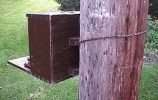
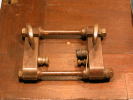
The "wrecking clamp" is used to tap the telegraph line. The Morse system as used in the United States is a series circuit, thus to "tap" the line the circuit must be broken and the instrument inserted. The wrecking clamp attaches to the telegraph wire, at which point the wire can be cut. The wires from the box relay are attached to the binding posts on the wrecking clamp. The telegraph wire requires splicing after the wrecking clamp is removed. The D&RGW installed "break irons" in their lines which allowed non-destructive tapping of the telegraph lines, however, these were not always located close enough to a wreck site to be used.
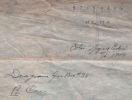
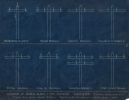
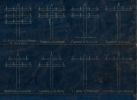
The "pole diagram" tells the telegrapher which wire to tap into to reach a desired location in the D&RGW system.
| |
| |
 |
 |
 |
 |
|
| |
| |
Wrecking set attached to a telegraph pole. |
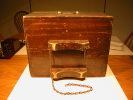
The back of the box showing how the chain is used. |
The back of the box showing the chain and the curved wood brackets. |
The box with front desk open. Box relay in upper compartment, wiring for attaching to telegraph lines in bottom compartment. |
| |
| |
 |
 |
 |
 |
|
| |
| |
The box relay, which is an early telegraph transceiver. |
The "Lewis" patent telegraph key (circa 1870s). |
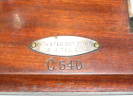
Oval plate on box relay: "PATENTED OCT. 10. 1871, W.U. TEL. CO." |
Handwritten on back of pole diagram "Diagram for Box #34 B. Car" |
| |
| |
 |
 |
 |
 |
|
| |
| |
Bottom half of pole diagram. |
Top half of pole diagram. |
The sounder end of the box relay. |
The "wrecking clamp". |