Insulators
Insulators are the glass devices used to suspend the wire in the air and prevent leakage of electrical current to the ground. The glass insulator was one of the major innovations required to make early telegraph and telephone circuits possible. The collection and study of these industrial artifacts has become a well established, mainstream hobby. Thus there is a great body of information and a lot of people willing to share their information on these glass devices.
Brent Burger describes some of his field collecting experiences, which gives us some clues as to the types of insulators used by the D&RGW:
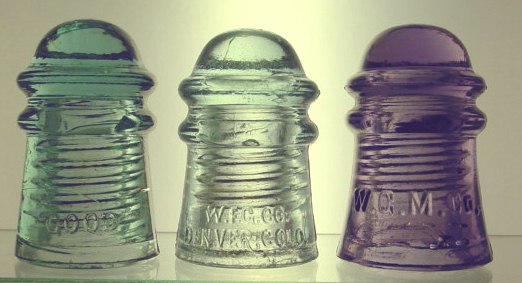
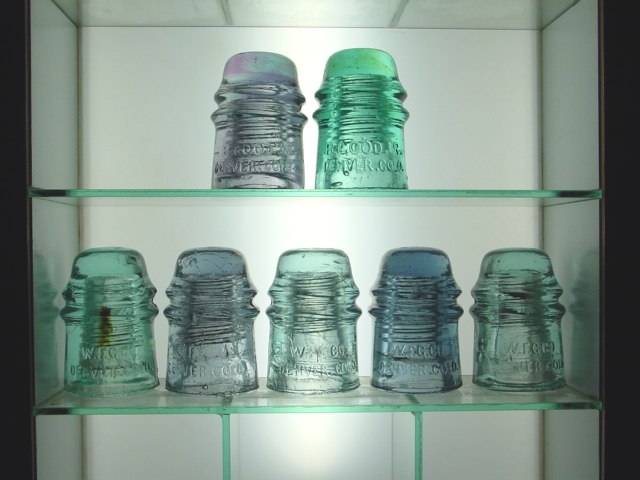
The D&RG lines I picked years ago had CD 126 "blobtops", which would probably date to the original 1880 construction. There were probably many others, too (?) I do not know the hard details of each line and when they were built, to get all nitty gritty. I do know some general stuff about the NG lines, and know a whole lot about insulator history, especially as it pertains to Colorado and the mining booms. You ask, I shall deliver! Sam March of the Square Nail Gang of the Friends has asked similar Q's for the rebuild of some line near the Osier depot. You will have to hold my hand on what line and when built. I am just getting into this NG stuff on a 12inch to the foot scale, so I am really GREEN ! Ask me about the old South Park, and I am much more knowledgeable. Trouble is, .... all gone! Is/was Antonito a NG - SG interchange? What lines ran where? We were picking in the Antonito area, but I was young and didn't know where I was. Seem to recall going to Chama and Taos, but not sure. Here are some pix. Stock70 shows a green blob. The ones out of D&RG territory were light aqua, not green. Another shot or two shows Denver made pieces. The plant was in Valverde and made insulators from 1897 to 1909. Had a siding on the old South park and later with the C&S.
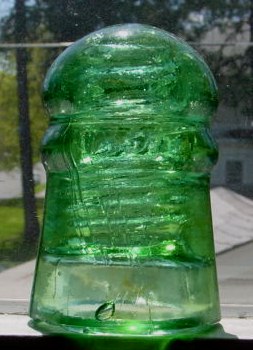
This could get complicated! The "blobtops" will be marked:
W.BROOKFIELD/ 55 FULTON ST./ N.Y.  with a combination of patent dates, OR ....
substitute 45 CLIFF ST. as the address.

    Brookfield dates:  55 Fulton  =  1865 - 1882
                       45 Cliff   =   1882 - 1890
                       83 Fulton  =   1890 - 1897

After 1897 they quit using a street address.  They were the first LARGE
mf'r. of glass insulators.  Out of business in 1922.
Hemingray was another large company, but did not get big till the 80's-90's. The earliest Hemi's were marked with only: PATENT DEC. 19, 1871. In the mid 80's they began marking their stuff: H.G.CO. and then phased in the HEMINGRAY name. Insulators made with the Hemingray name till 1967.
I do not believe the Denvers I sent pix of were used on RR applications. These were designed more for telephone use. The RR's preferred larger "hoopskirts" and "beehives". I took these Denvers off phone lines in the San Juan area. My only known type to have come off the D&RG lines was the "blob". These are ancient, but common. I had never seen them still in use at the time we picked some there. I am sure others were used as damage replacements or when circuits were added. Some hiking the R-O-W with a grub hook is in order to get an accurate feel for what was used. Give me this info, and I can fill you in on dates, mfr., &c.
For the accurate rebuilding of lines, you need to assess what line, and what period you will build to. The South Park ran 6 foot single arms with wide spaced pins, 2 per side, over Boreas and on to Fremont. I believe I have a photo from 1887 and several from the end that show it changed little over the years. The high and dry of that region allows poles and other wood to remain serviceable for 100+ years in good condtions. As I recall, the poles around Antonito were original 1880 material when I was there in 75.
Brent Burger
Spokane